


Benign Prostatic Hyperplasia
Enlargement of prostate tissue often shows up as a weaker urine stream, nighttime urination, and incomplete emptying. It is not the same as prostate cancer, but it still deserves attention because it affects quality of life and urinary function.



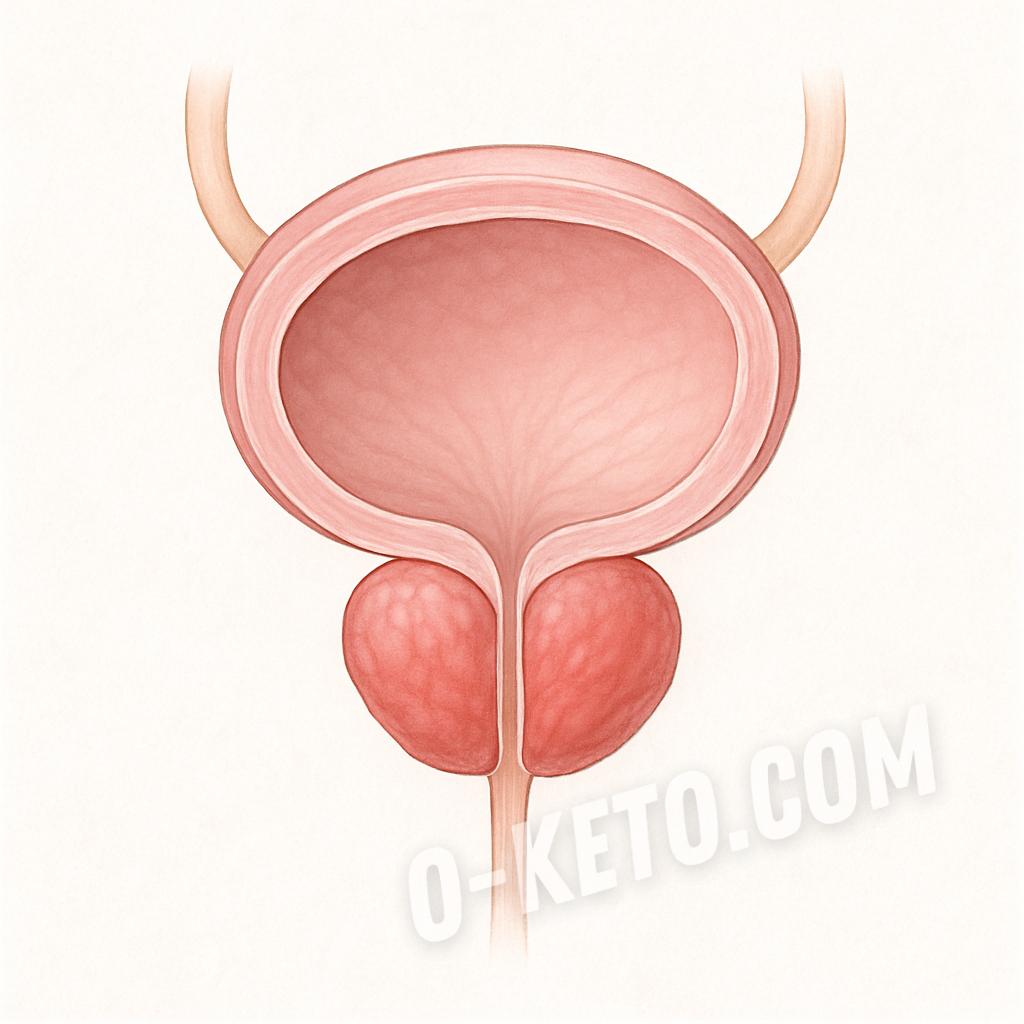
Benign prostatic hyperplasia is an increase in prostate tissue volume that most often develops in middle-aged and older men. In everyday language it is often called prostate enlargement or prostate adenoma. The process is linked not simply to the total amount of testosterone in the body, but to local hormonal activity inside the gland itself. In the early stages a man usually notices changes in urination rather than pain: the stream becomes weaker, nighttime urination becomes more frequent, and there may be a persistent feeling that the bladder does not empty completely. This condition is not the same as prostate cancer, but it still deserves attention because it can significantly reduce quality of life and increase stress on the urinary tract.
What happens inside the prostate
The prostate is sensitive to androgens, especially dihydrotestosterone. This hormone is formed from testosterone by the enzyme 5-alpha-reductase inside the tissues. When local activity of this pathway becomes excessive, prostate cells are more likely to remain in a growth-oriented state and less likely to leave space through normal turnover. As a result, the gland gradually enlarges, compresses part of the urethra, and changes the behavior of nearby smooth muscle. That is why the condition is not only a matter of tissue size but also a functional problem that affects urination.
The balance between mechanical compression and muscle-related urinary symptoms is not identical in every man. Some men first notice only weaker flow and nighttime waking, while others develop retention-like symptoms much sooner. For that reason, ultrasound findings and symptom severity do not always match perfectly.
Common symptoms
The classic complaints are urinary. A man may need extra time to begin urinating, the stream may become thin, effort may be needed to finish, and the feeling of incomplete emptying may remain after the bathroom. Frequent daytime urination, urgency, and repeated waking at night are also common. Sometimes pain is minimal and the main burden is poor sleep, constant irritation, and reduced day-to-day comfort.
If the condition progresses, there may be episodes of significant urinary retention, leakage, repeated urinary infections, bladder dysfunction, and additional strain on the kidneys. That is why benign enlargement should not be dismissed as a harmless part of aging.
What influences progression
Age increases risk, but the course is shaped by more than age alone. Local androgen metabolism, chronic low-grade inflammation, metabolic syndrome, excess visceral fat, insulin resistance, poor sleep, and low physical activity can all contribute. Symptoms may become more noticeable in men who regularly drink alcohol in the evening, overeat late, take in too much fluid before sleep, or live with poorly controlled blood sugar and chronic stress.
From a nutrition and lifestyle perspective it is important not to promise dramatic reversal through diet alone. Even so, better weight control, lower inflammatory load, improved glycemic control, and reduced visceral obesity often help reduce the burden of symptoms. For some men a low-carb or moderately lower-carb dietary pattern is useful mainly because it improves the metabolic background rather than because it directly treats the prostate.
Which tests are helpful
Evaluation usually includes symptoms, physical examination, ultrasound or transrectal imaging, urinalysis, and in many cases an assessment of residual urine. PSA can also be useful, but only in the right context. A single number never replaces a proper interpretation. A normal PSA does not rule out meaningful enlargement, and an elevated PSA does not automatically mean cancer. It should be interpreted together with symptoms, prostate volume, inflammation markers, and follow-up over time.
If urinary symptoms are accompanied by blood in the urine, fever, severe pain, complete urinary retention, repeated infections, or signs of kidney stress, this is no longer a situation for casual self-observation. In that setting prompt in-person urologic evaluation is appropriate.
Why self-treatment has limits
Many men with urinary symptoms look for gentler plant-based support, especially if they want to avoid the adverse effects sometimes associated with stronger medications. That can be reasonable as part of a broader strategy, but supplements should not replace evaluation when symptoms are significant, rapidly worsening, or mixed with infection, stones, neurologic bladder dysfunction, or concern for malignancy.
Extra caution is warranted in men who already take alpha-blockers, anticoagulants, blood-pressure medicines, or are being treated for chronic prostatitis. Any product that may influence hormonal conversion, inflammation, or blood properties should be considered in the context of the full treatment plan rather than added blindly.
Why the metabolic context matters
Benign prostatic hyperplasia is not only a local age-related urologic issue. It frequently coexists with abdominal obesity, insulin resistance, hypertension, and chronic inflammatory burden. That is why work on body composition, sleep quality, physical activity, and glucose regulation often becomes an important background layer. The prostate does not exist separately from the rest of the body, and a worse metabolic environment tends to support swelling, irritation, and poor urinary function.
In practical terms, the most useful strategy usually combines proper urologic follow-up with metabolic support rather than chaotic self-treatment. A clearer diagnosis, monitoring over time, and a calmer systemic background often make both medical treatment and supportive measures more effective.
If you have any questions about the term "Benign Prostatic Hyperplasia", you can ask them to AI. Please note, a low-cost OpenAI model is used. It may answer questions about disease treatment with errors!

 1 / 4
1 / 4
 1 / 4
1 / 4 1 / 4
1 / 4
 1 / 4
1 / 4 1 / 4
1 / 4


