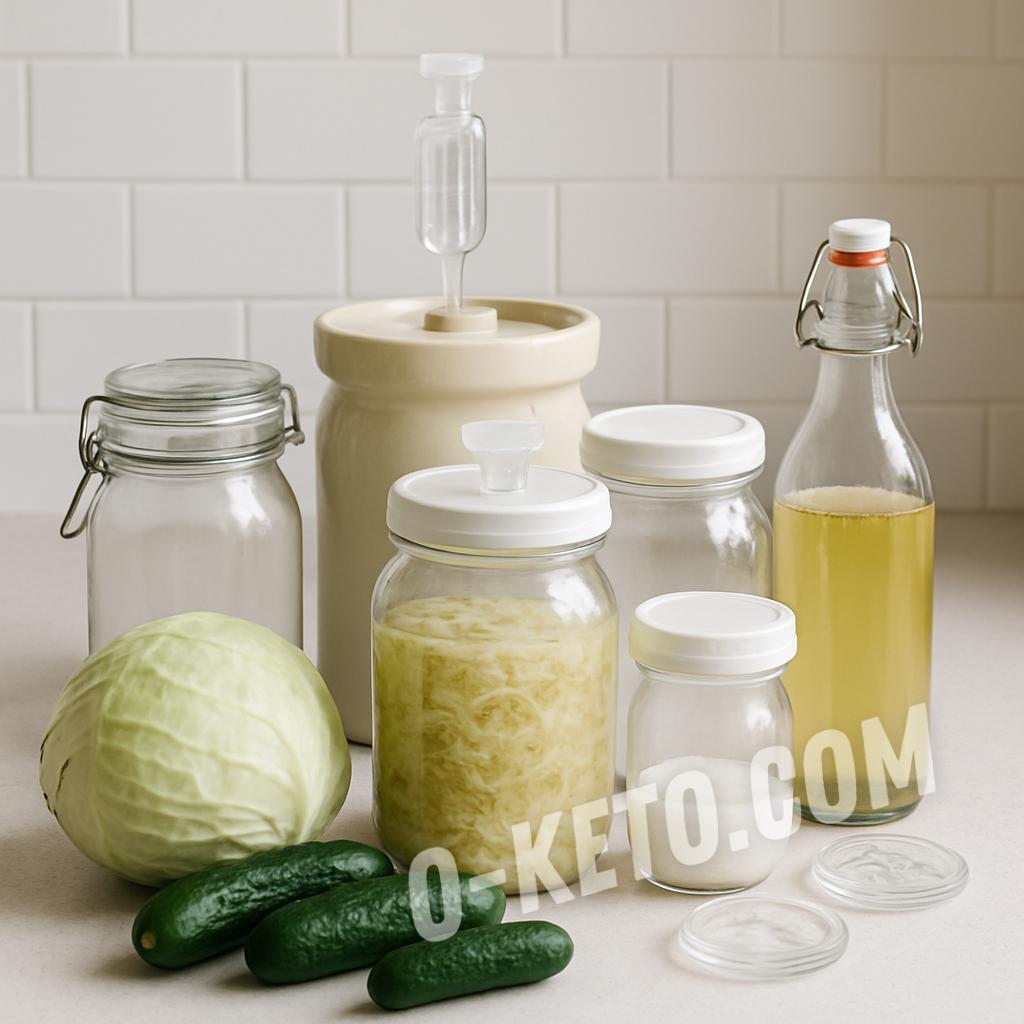

For home fermentation, the container is just as important as salt, temperature, and the freshness of the ingredients. The jar, lid, weight, and the shape of the neck affect whether the product will ferment peacefully under the brine or start to come into contact with air, dry out, mold, and smell off.
The main principle is simple: the container must be food-safe, chemically neutral, clean, without cracks, chips, or rust. Beyond that, the choice depends on what exactly you are fermenting: cabbage, cucumbers, vegetable mixes, kombucha, tea herbs, or drinks with secondary fermentation.
Why the container is important for fermentation
During fermentation, several processes occur simultaneously in the container: the ingredients release juice, the brine becomes sour, microorganisms produce gas, and the surface of the product may come into contact with oxygen. A good container helps manage all of this without unnecessary fuss.
The main practical aspects depend on the container:
- the product can be fully pressed under the brine;
- there is space for gas to escape, and the jar is not ruptured by pressure;
- the sour brine does not come into contact with unsuitable metal, paint, or unknown plastic;
- the walls are easy to wash, and old organic matter does not remain in scratches;
- the volume is suitable for the portion, so there is not too much air left at the top.
The ideal container should not actively participate in the process. It simply creates stable conditions: it holds the product, brine, weight, and lid without imparting smells, aftertastes, or unwanted substances to the food.
What materials are suitable
For most home tasks, glass and quality ceramics work best. Food-grade plastic can be used cautiously, but it is not the best option for long sour fermentation. Metal is only suitable in limited cases and should not come into prolonged contact with brine.
| Material | When it is suitable | What to look for |
| glass | vegetables, starters, kombucha, small batches | wide neck, whole walls, no chips, easy to wash |
| food-grade ceramics | fermenting cabbage, cucumbers, and large batches of vegetables | glaze must be food-safe, without cracks and questionable coatings |
| food-grade plastic | short fermentation, large volumes, temporary containers | food labeling, no odor and deep scratches |
| stainless steel | short contact, spoons, funnels, sieves, working tools | not to be used as the main container for long sour brine |
| wood | individual traditional processes with good care | for regular home fermentation, it is better not to use as the main container |
If there are doubts about the material, it is better to choose a regular glass jar. It may not be the most romantic, but it is the most understandable and predictable option to start with.
Glass jars
A glass jar is the basic option for home fermentation. It does not react with sour brine, does not absorb odors, and allows you to see bubbles, the level of brine, the color of the product, and any possible problems on the surface.
For vegetables, jars with wide mouths are more convenient. They make it easier to pack cabbage, cucumbers, carrots, beets, kimchi, curtido, and vegetable mixes. Narrow jars are beautiful, but they make it difficult to properly pack the product, place the weight, and then retrieve the finished fermentation.
Before use, the jar should be checked:
- there are no chips on the neck, as they interfere with the lid and can injure hands;
- there are no cracks on the bottom and walls, especially if the jar will be kept in warmth;
- the jar does not smell of old preservation, vinegar, detergent, or mold;
- the volume is suitable for the batch, and after packing, there is space for brine and the rise of the mass;
- the jar can be easily washed by hand, with a brush, or sponge.
For initial experiments, jars of 0.5-1 L are convenient. If the recipe is already understood, you can take 1.5-3 L. For very large batches, glass is also suitable, but a heavy full jar is harder to carry, wash, and safely place in the refrigerator.
Ceramic fermentation containers
Ceramic fermentation vessels are great for those who regularly ferment cabbage, cucumbers, or large vegetable mixes. They are heavy, stable, often come with weights, and sometimes have a water lock around the edge of the lid.
The advantage of ceramics is that it protects the product from light and maintains a more stable temperature. The downside is the price, weight, and the need to carefully check the quality of the coating. Sour brine should not come into contact with cracks, chips, and questionable glaze.
When choosing a ceramic container, three signs are important:
- the manufacturer explicitly states that the glaze is food-safe and suitable for fermentation;
- there are no crazing, cracks, rough areas, or places where brine can seep into the porous base;
- the lid, weight, and neck allow the vegetables to stay under the brine, rather than just beautifully covering the container.
Old ceramics from the market or from a family cupboard may look cozy, but for sour fermentation, this is not always a safe choice. If the origin of the glaze is unknown, it is better not to use such containers for brine.
Weight and water lock
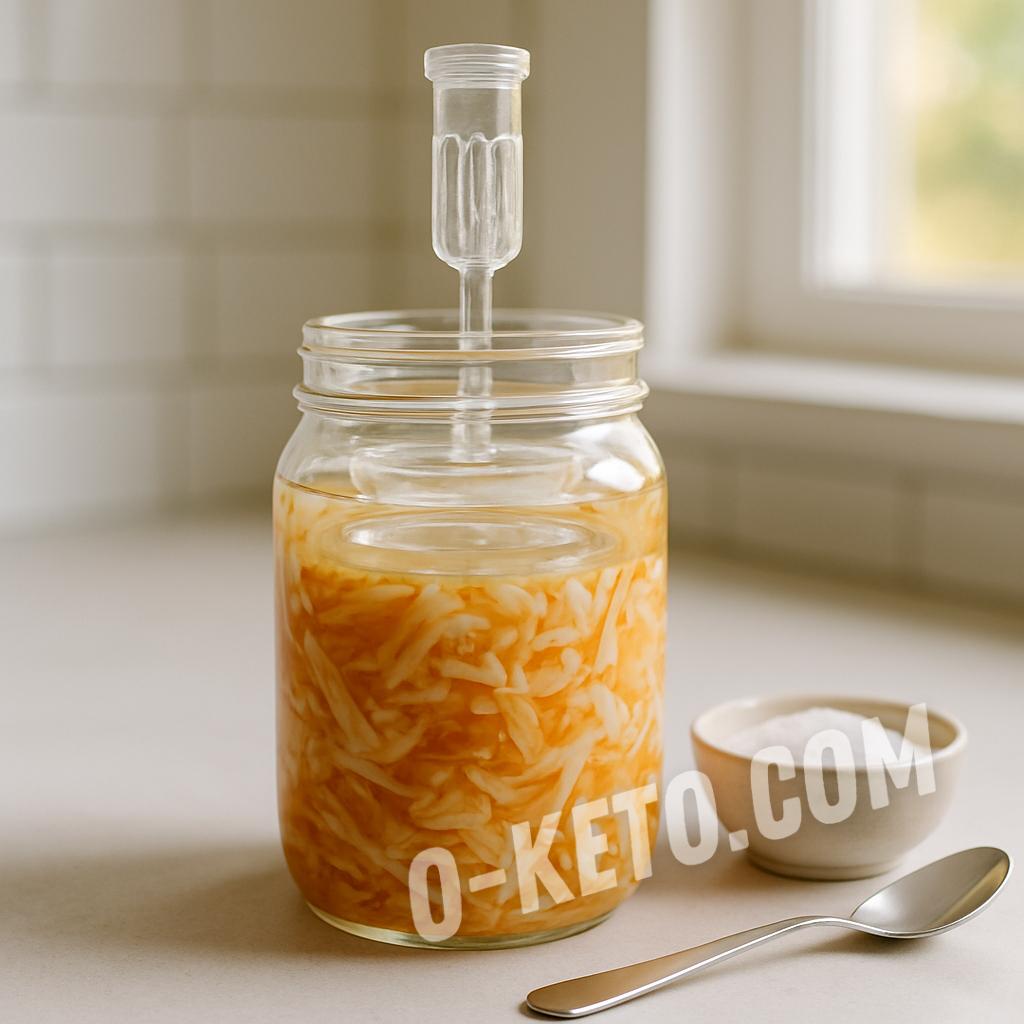
A weight is needed for vegetables that must remain under the brine. While cabbage, cucumbers, or vegetable mixes are covered with liquid, the process goes more smoothly: less contact with oxygen, lower risk of the upper layer drying out, yeast and mold.
A water lock or fermentation lid helps release carbon dioxide while simultaneously limiting access to oxygen. This is not a mandatory purchase for the first jar of cabbage, but it is a very convenient item if fermentation becomes regular.
| Part | What it is for | What to choose |
| glass weight | keeps vegetables under the brine | convenient, heavy, does not absorb odors |
| ceramic weight | suitable for ceramic fermentation vessels | food-safe glaze and absence of cracks are important |
| brine bag | temporary replacement for weight | use a thick food-grade bag and the same brine as in the jar |
| lid with water lock | releases gas and reduces contact with air | convenient for vegetables, kimchi, sauces, and active fermentation |
| regular lid | protects from dust but requires pressure monitoring | do not screw tightly during the active phase or regularly release gas |
If fermentation is happening in a regular jar without a water lock, the lid should not be tightened firmly in the first few days. Gas needs to escape. Otherwise, the brine may overflow, the lid may warp, and in bottles with active drinks, pressure becomes a safety issue.
What lids to choose
The lid should solve a specific task. For vegetables, it protects from dust and insects but should not seal off active gas production without monitoring. For kombucha, a non-airtight lid, cloth, or paper filter is needed. For secondary fermentation of drinks, on the contrary, a sturdy bottle with a tight closure is required.
Convenient options include:
- regular screw lid is suitable for short fermentation if not overtightened and pressure is monitored;
- silicone fermentation lid releases gas and simplifies care for the jar;
- lid with water lock is convenient for active vegetable fermentations and sauces;
- cloth, cheesecloth, or coffee filter is suitable for kombucha during the first fermentation because the culture needs air;
- flip-top bottle is suitable for carbonated drinks, but only if it is designed for pressure.
Lids with rust, the smell of old preservation, chipped coatings, and deformed threads are better thrown away. A lid costs less than a spoiled batch and cleaning brine from all over the kitchen.
Containers for vegetables, kombucha, and drinks are chosen differently
The same jar is not always equally convenient for different tasks. Vegetables need brine, weight, and minimal air at the top. Kombucha needs oxygen and a wide surface. Carbonated drinks need a sturdy bottle that can withstand pressure.
| What you are fermenting | Best type of container | What is especially important |
| cabbage, kimchi, curtido, cucumbers | glass jar with a wide mouth or ceramic container | weight, brine above the product, space for liquid rise |
| kombucha | wide glass jar | fabric lid, air access, no metal in long contact |
| fermented sauces | jar with a water lock or loose lid | active gas production, pressure control, clean walls |
| carbonated drinks | sturdy flip-top bottles for pressure | space allowance, cooling after carbonation, careful opening |
| fermented herbal tea | not a jar with brine, but a tray, bag, or container for dried leaves | leaf moisture, air access in damaged tissue, timely drying |
The most common mistake is trying to solve everything with one beautiful container. For cabbage, weight is more important; for kombucha, air; for drinks, pressure; for herbs, not brine, but proper wilting and drying.
What volume to choose
It is better to choose the volume not “with a reserve,” but according to the actual portion. A jar that is too small quickly overflows with brine. A jar that is too large leaves too much air above the product and is inconvenient for the refrigerator.
| Volume | Convenient for what | Comment |
| 0.5 L | test batches, garlic, hot sauce, small vegetable mix | good for experiments but little space for active fermentation |
| 1 L | first batches of cabbage, cucumbers, curtido, kimchi | the most convenient starting size |
| 1.5-3 L | regular fermentation for the family | needs a stable weight and space in the refrigerator |
| 5 L and more | seasonal fermentation, large batches of cabbage | ceramics or thick glass are more convenient, but harder to manage |
| 0.5-1 L bottles | secondary fermentation of drinks | only bottles designed for pressure |
It is not necessary to fill the container to the very top. For vegetables, it is usually recommended to leave a few centimeters of space because in the first days, the brine rises, bubbles, and may overflow.
What is better not to use
Fermentation is an acidic and salty environment. It can draw out aftertaste and unwanted substances from materials that did not seem problematic in regular dry storage.
For home fermentation, it is better not to use:
- aluminum pots, bowls, and jars with a metal inner coating;
- copper, brass, galvanized buckets, and any containers of unknown metal composition;
- cast iron and carbon steel as the main container for acidic brine;
- enamelware with chips where brine contacts metal;
- ceramics with cracks, unknown glaze, or decorative painting inside;
- plastic containers with odors, scratches, sticky surfaces, or without food labeling;
- thin glass bottles for carbonated drinks;
- narrow decorative vessels that cannot be properly washed.
It is worth mentioning beautiful vintage jars and pitchers separately. They may be wonderful for dry storage, but for acidic brine, modern food-grade glass or ceramics with clear designations are safer.
How to prepare the containers
Sterility is not required for fermentation, but cleanliness is. Residues of grease, detergent, old mold, or food interfere with a normal start and can spoil the taste.
Before laying the ingredients, it is convenient to act step by step:
- wash the jar, lid, weight, and tools with hot water and a mild detergent;
- rinse well to ensure no detergent smell remains on the surface;
- inspect the neck, bottom, lid, and weight for chips, cracks, rust, and residue;
- let the containers drain or dry with a clean towel;
- place the jar on a plate or tray if the brine may rise and overflow in the first few days.
Boiling water can be used for glass that can withstand heat, but it is not advisable to pour boiling water into a cold jar without preheating: the glass may crack. If sterilization is needed, it is better to use a familiar safe method for jars and not rush with sharp temperature changes.
Checklist before purchasing
Before buying a special fermentation container, it is useful to understand which processes you will be doing most often. For one jar of sauerkraut a month, it is not necessary to immediately buy a heavy ceramic crock. For regular batches, sauces, and kimchi, fermentation lids and proper weights greatly simplify life.
Check several points:
- the container is made of glass, food-grade ceramics, or a clear food material;
- the neck is wide enough to pack the product and place the weight;
- the lid allows gas to escape or easily controls pressure;
- the volume corresponds to a normal portion, not just a pretty picture;
- the jar, weight, and lid can be easily washed without hard-to-reach crevices;
- for drinks, the bottle is designed for pressure, not just closes nicely;
- for kombucha, the container is wide, glass, and closes with cloth, not an airtight lid.
If you are just starting, the optimal set looks simple: several glass jars with wide mouths, glass weights, a couple of fermentation lids, and separate sturdy bottles for drinks. Everything else can be purchased later based on your actual habits.
Conclusion
For home fermentation, it is better to choose containers made of glass or food-grade ceramics: they do not react with sour brine, are easy to wash, and allow you to control the process. For vegetables, wide necks, weights, and the ability to release gas are important. For kombucha, a glass jar with air access is needed. For carbonated drinks, only sturdy bottles designed for pressure are required.
It is not advisable to use aluminum, copper, rusty lids, chipped enamel, unknown ceramic glaze, scratched plastic, and thin glass for drinks. A good container does not make fermentation more complicated: it helps the product stay under the brine, release gas calmly, and reach the desired taste without unnecessary risks.
Sources
- Preserving food at home: Fermentation — University of Minnesota Extension
- Safely Fermenting Food at Home: Extension Food Safety Fact Sheet — University of Missouri Extension
- Fermenting FAQ — University of Illinois Extension
- Fun with Fermentation — University of Illinois Extension
- Complete Guide to Home Canning: Fermented Foods — National Center for Home Food Preservation