Homemade fermented vegetables can look unusual even when everything is fine. The brine turns cloudy, bubbles appear, vegetables change color, and white sediment collects at the bottom. But next to normal signs there are warning signs too: fuzzy mold, rotten smell, stringy slime, slippery vegetables, pink or black spots.
First separate normal signs from problems
Living fermentation has normal external signs. They can look alarming if you ferment only occasionally, but by themselves they do not mean spoilage.
| what you see | what it usually means | what else to check |
| cloudy brine | lactic acid bacteria are working, and the liquid contains many suspended microbial particles | the smell should be sour, vegetable-like, spicy, without rot |
| gas bubbles | active fermentation is underway and carbon dioxide is forming | the jar should not be swollen to dangerous pressure |
| white sediment at the bottom | particles of vegetables, salt, bacteria, and yeast suspension settle out | sediment should not come together with bad smell, slime, and mold |
| sour smell | lactic acid is accumulating | sour smell should not be rotten, fecal, meaty, or chemical |
| vegetables have faded | pigments move into the brine or change in an acidic environment | paleness is less worrying than mold spots, pink slime, or black areas |
The main rule is simple: judge not one sign, but the combination of appearance, smell, texture, whether vegetables are under the brine, and the overall state of the jar.
How to tell kahm from mold
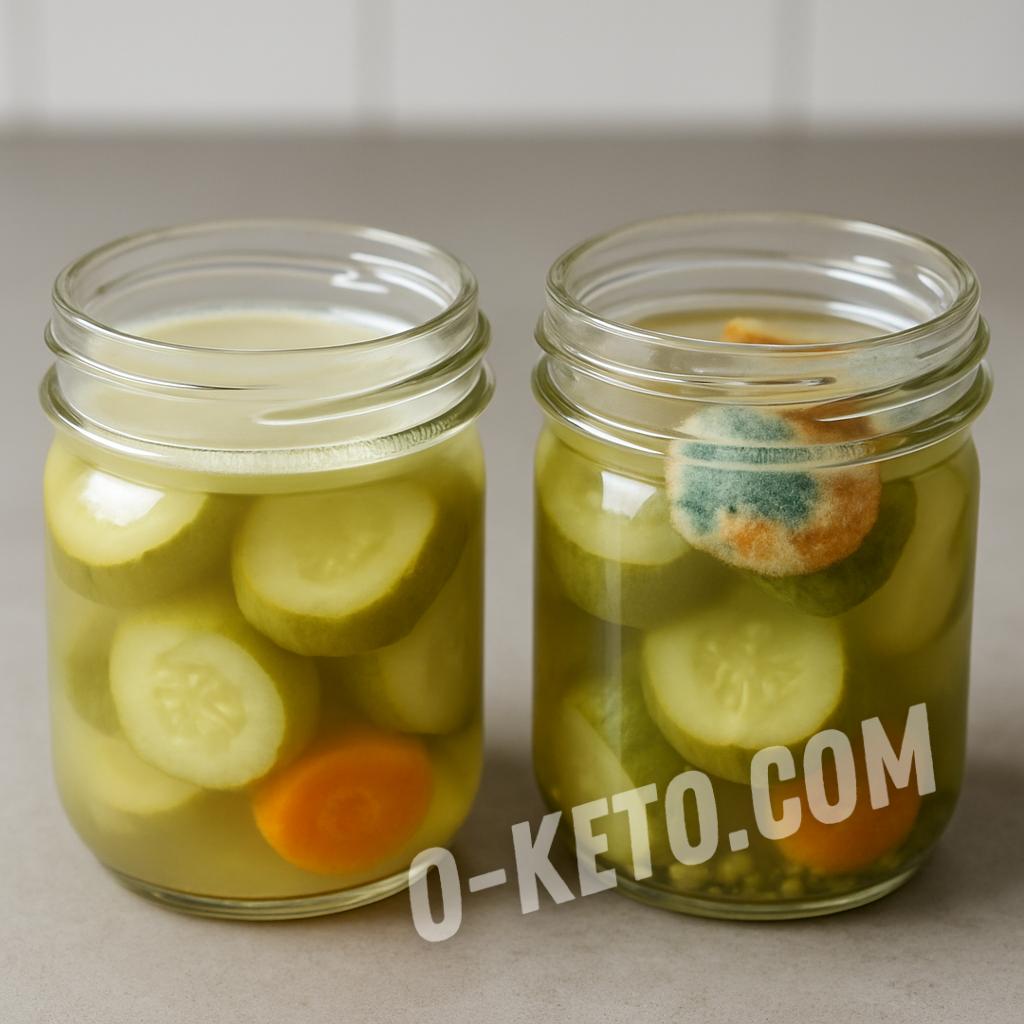
A white film on the surface causes panic most often. But white growth on a ferment can be different things. A thin matte film usually resembles kahm yeast, while fuzzy islands, spots, and hairs look more like mold.
| sign | looks like kahm | looks like mold |
| shape | thin even film or wrinkled whitish surface | islands, circles, clumps, raised coating |
| texture | flat, matte, sometimes slightly folded | fluffy, hairy, velvety, or web-like |
| color | white, cream, grayish-white | green, blue, black, pink, orange, gray, or white and fluffy |
| location | on the brine surface, especially where it contacts air | on protruding vegetable pieces, jar walls, or brine surface |
| smell | may be yeasty, bready, slightly stale | often unpleasant, moldy, damp, rotten, or sharp |
| decision | can sometimes be removed if all other signs are normal | it is better to discard the product |
Kahm itself is usually not the main danger, but it shows that conditions were not ideal: too much oxygen, too little brine above the vegetables, too much warmth, too little salt, or a jar that stayed open for too long.
Mold is different. In soft vegetables and brine, it can spread deeper than what is visible on top.
When the jar should be discarded immediately
Some signs are not worth arguing with, tasting “one piece to check,” or trying to save the top layer. Discard the jar if you see or smell any of the following:
- fuzzy mold of any color;
- green, black, pink, orange, or blue spots on the surface;
- rotten, putrid, fecal, meaty, or sharply chemical smell;
- vegetables have become slippery, stringy, falling apart, and smell unpleasant;
- brine stretches into threads like syrup or slime;
- the jar spent a long time with vegetables above the brine, and spots plus spoilage smell appeared on top;
- the product feels “not right,” and you cannot confidently tell kahm from mold.
Fermentation should not require heroics. If a jar raises serious doubt, it is safer to lose the vegetables than to test your stomach’s resilience.
Smell: sour, yeasty, or rotten
Smell is often more reliable than color. A normal ferment may smell sharp, sour, and spicy, especially if it contains garlic, onion, pepper, cabbage, or radish. But sharpness should not turn into rot.
| smell | how to read it | what to do |
| pleasantly sour, vegetable-like, briny | usual smell of lactic fermentation | check taste and texture, then refrigerate when ready |
| yeasty, bready, slightly beer-like | yeast activity or kahm on the surface is possible | inspect the surface, remove film if appearance is normal, and chill the product |
| sulfurous, cabbage-like, sharp | with cabbage, onion, and garlic this can happen in early stages | see whether the smell fades after airing and whether there is slime or mold |
| rotten, putrid, fecal | looks more like spoilage than normal acidity | discard |
| solvent, acetone, sharp chemical note | unwanted yeast activity or process failure is possible | do not use, especially if there is film, pressure, slime, or unpleasant taste |
Do not smell the jar as if you were tasting wine. Open it carefully, keep your face away from the mouth of the jar, and assess the general odor. If the smell is immediately and clearly unpleasant, do not taste the product.
Slime and stringy brine
Slight viscosity can occur with some vegetables or spices, but true slime is a bad sign. This is especially true if the brine pulls into threads, vegetables feel slippery, and the smell has become unpleasant.
| situation | possible cause | decision |
| brine is slightly cloudy but still liquid | normal bacterial activity | keep it if smell and taste are normal |
| white sediment at the bottom, liquid is not stringy | ordinary fermentation sediment | can be used if the smell is normal |
| brine has become viscous and sticky | microflora imbalance, too little salt, unsuitable temperature | better to discard |
| vegetables are covered with slime and smell unpleasant | looks like spoilage | discard without tasting |
Slime appears more often when conditions did not let lactic acid bacteria acidify the environment quickly: too little salt, temperature too low or too high, poor-quality vegetables, or surface contact with air.
Soft vegetables: spoilage or just poor texture
Softness does not always mean danger. Cucumbers, zucchini, peppers, and cabbage can soften from high temperature, long fermentation, weak brine, or slicing too thinly. This can be unpleasant, but it is not always unsafe.
It is better to judge softness by the combination of signs:
| texture | what it may mean | what to do |
| vegetables became softer but smell pleasantly sour | over-fermentation or fermentation that was too warm | can be eaten if there is no mold, slime, or bad smell |
| vegetables softened and lost crunch | texture failure, too little salt, or a warm place | use quickly or in cooking if the product is safe by smell and appearance |
| vegetables are slippery, falling apart, and smell rotten | looks like spoilage | discard |
| top pieces are soft and were above the brine | oxygen contact and risk of surface spoilage | discard the jar if there are spots, smell, or mold |
If the only problem is crunch, it is a culinary failure. If softness comes together with slime, spots, and bad smell, it is a safety issue.
Color: which changes are acceptable
Fermentation changes vegetable color. Beetroot stains the brine, red cabbage can shift toward pink or purple, and garlic can sometimes turn blue or green because of reactions between sulfur compounds and an acidic environment. Not every color change is dangerous.
| color or spot | often normal | worrying |
| cloudy-white brine | yes, if the smell is sour and there is no slime | no, if there is stringiness and rot |
| pink brine from beetroot or red cabbage | yes, if the color is even | no, if there is pink slime or separate surface spots |
| blue or green garlic | often a garlic reaction in an acidic environment | moldy coating and bad smell are more dangerous than the garlic shade itself |
| black dots from spices | normal if they are pepper, mustard, cumin, or other spices | bad if black coating grows in patches and looks fuzzy |
| orange, green, or black mold | no | discard |
If the color changed evenly because of vegetables or spices, that is one thing. If separate growing spots, islands, fuzziness, or slimy streaks appeared, that is another.
Brine, bubbles, and pressure in the jar
Gas is a normal part of fermentation. But pressure needs control, especially if the jar is tightly closed. An active ferment can push out brine, pop the lid, or make opening the jar unpleasant.
| sign | normal | when to be cautious |
| bubbles rise upward | active fermentation | if rot, slime, or mold is also present |
| brine leaked over the edge | often the jar is overfilled or the process is very active | if vegetables were left without liquid afterward |
| lid is strongly swollen | pressure has accumulated in a closed jar | open carefully after assessing smell and appearance |
| there is gas, but no acidity | the process may have gone in the wrong direction or has not reached enough acidity yet | assess smell, salt, temperature, and time |
If a ferment stands under a tight lid, it is periodically “burped,” or a system is used that releases gas. This does not make the product safe by itself, but it lowers the risk of pressure and brine overflow.
What can be saved
Only a product without mold, rot, slime, and suspicious smell can be saved. If the problem looks like surface kahm or a small technical mistake, proceed like this:
- carefully remove the film with a clean spoon;
- remove all floating vegetable and spice pieces from the surface;
- wipe the inside jar walls above the brine level with a clean cloth and vinegar;
- press vegetables below the brine level;
- add a clean weight if vegetables float up;
- add brine of suitable saltiness if needed;
- put the jar in the refrigerator if the taste is already sour enough.
After this treatment, use the product sooner and keep watching it. If the film keeps returning, the smell worsens, or colored growth appears, it is better to discard the jar.
What cannot be saved by removing the top layer
Some mistakes cannot be fixed with a spoon. The surface can look like a local problem, but brine and soft vegetables create an environment where unwanted microorganisms and their products can spread beyond the visible spot.
Do not try to save a ferment in these cases:
- there is fuzzy mold, even if it is only on one piece;
- mold is colored, dark, or growing in islands;
- top vegetables spent a long time above the brine;
- the smell became rotten or putrid;
- the brine is stringy and slimy;
- the taste is clearly unpleasant, bitter-rotten, or chemical;
- the jar stood in heat, and fermentation developed spots plus an unpleasant smell.
“I will remove the top and the rest is fine” does not work well for soft fermented vegetables. This is not hard cheese where a section can sometimes be cut away. The brine connects the whole jar into one environment.
Why problems appear
Spoilage rarely appears “just because.” It usually has a technical cause. If you understand the cause, the next jar will be more stable.
These conditions most often trigger problems:
- vegetables stick out above the brine and contact oxygen;
- there is too much free air in the jar;
- there is too little salt, or it was measured by eye;
- temperature is too high, especially above ordinary room temperature;
- temperature is too low, and acidification proceeds slowly;
- vegetables were overripe, damaged, or starting to rot;
- the jar, lid, weight, or cutting board was poorly washed;
- brine was made with water that had a strong chlorine smell;
- the jar was opened often, tasted with a dirty spoon, or vegetables were returned back into it.
Successful fermentation is not sterility, but the right selection of microflora. Salt, lack of oxygen, and gradual acidification help lactic acid bacteria take the leading position. When these conditions are broken, the chance of yeast, mold, and putrefactive microflora rises.
How to check the jar before tasting
Taste a ferment only after inspection. It is convenient to follow the same algorithm each time so you do not miss an obvious problem.
The checking order is:
- look whether all vegetables are under the brine;
- assess the surface: no fuzzy islands, colored spots, or slime;
- check jar walls above the brine;
- open the jar carefully and assess the smell;
- look at the brine: cloudiness is acceptable, stringy slime is not;
- assess the texture of top vegetables with a clean spoon;
- only if appearance, smell, and texture are normal, taste a small piece;
- if the taste is unpleasant, rotten, chemical, or doubtful, do not eat the product.
pH strips can be an additional clue: a well-acidified vegetable ferment is usually safer than a jar where acidity never developed. But home pH does not replace checking mold, smell, slime, and storage conditions.
How to reduce the risk of the problem returning
If a ferment spoiled, it is more useful to examine the weak point in the process than to blame yourself. Most recurring problems are fixed by technique.
Next time, check these points:
- weigh salt instead of sprinkling it by eye;
- use fresh vegetables without soft or spoiled areas;
- pack vegetables tightly so there is less air between them;
- use a weight that keeps all pieces under the brine;
- leave room for brine rise, but not half a jar of empty space;
- keep the jar away from direct sun and overheating;
- do not taste the ferment with a dirty spoon;
- refrigerate the product after it is ready;
- if kahm appears constantly, reduce oxygen access and try a more precise brine;
- if vegetables constantly soften, lower the temperature and do not keep the ferment warm for too long.
Sometimes the issue is not the recipe but kitchen conditions: summer is too hot, the jar is too large for a small portion, the weight does not hold vegetables well, or the lid lets in too much air.
Conclusion
A white film on fermented vegetables does not always mean spoilage: a flat whitish film often resembles kahm, while cloudy brine, bubbles, and white sediment can be normal fermentation signs. But fuzzy mold, colored spots, rotten smell, stringy slime, slippery vegetables, and unpleasant taste are reasons to discard the jar.
The most reliable approach is not to save a doubtful product at any cost. If the ferment looks clean, smells pleasantly sour, the vegetables are under the brine, and the problem is limited to a thin surface film, it can sometimes be removed and the jar chilled. If there is mold, slime, or spoilage smell, the product should not be tasted.
Sources
- Molds on Food: Are They Dangerous? — Food Safety and Inspection Service, U.S. Department of Agriculture
- Preserving food at home: Fermentation — University of Minnesota Extension
- Making and Using Sauerkraut — National Center for Home Food Preservation
- Safely Fermenting Food at Home: Extension Food Safety Fact Sheet
- Food Safety, Waste Minimization, and Value Enhancement of Fermented and Lightly Processed Vegetables