


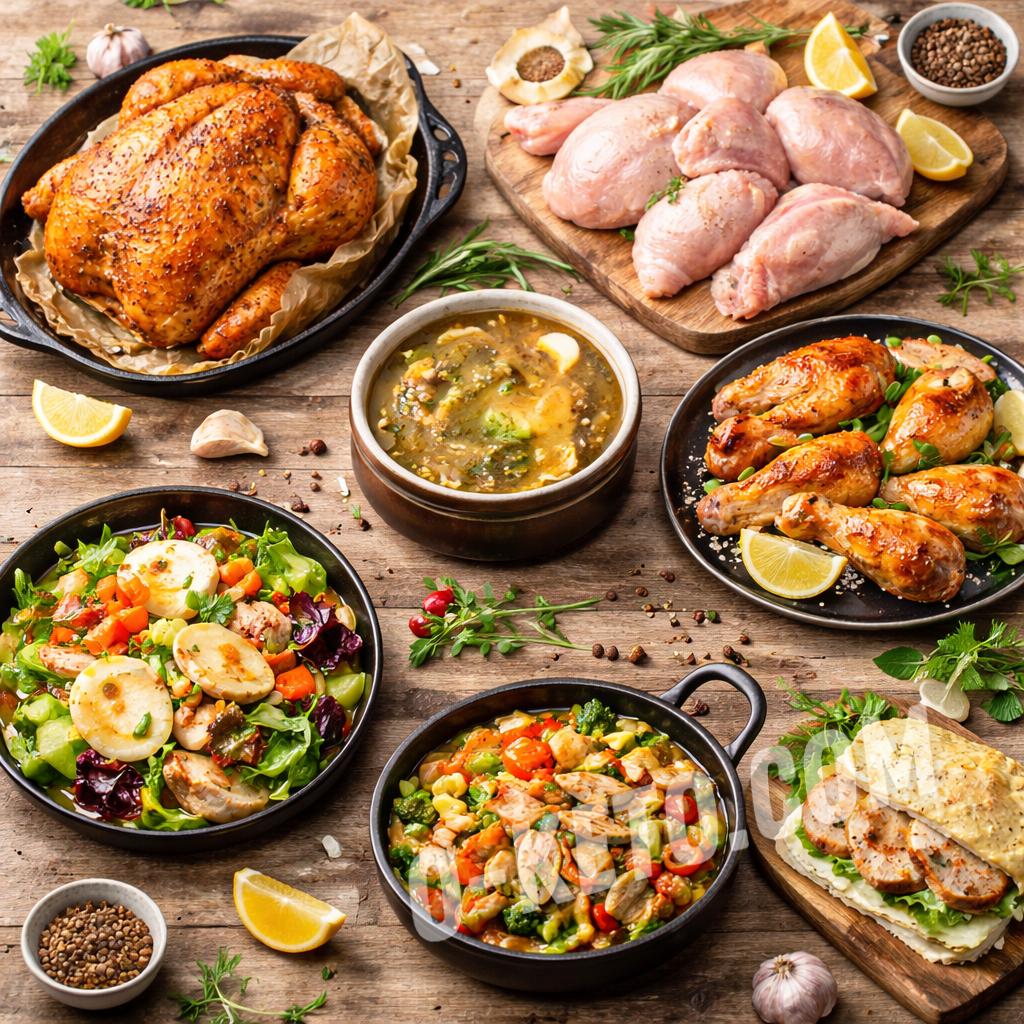

You can cook chicken whole or in parts, but the best result almost always comes from the approach “buy a whole one, cook it in different ways.”
It’s not about the recipes, but rather that different parts of the bird vary in fat content, structure, and heating speed, so under the same conditions, the breast can easily dry out while the legs are still reaching the desired temperature.
Why a whole chicken often loses to parts
The different pieces of chicken behave differently, and this cannot be fully compensated for with just one cooking time and temperature.
The thighs have significantly more fat than the breast, making them inherently juicier and tastier. The bones of the drumsticks and thighs heat up more slowly and act as heat sinks, which means that by the time the breast is done, the meat in the legs often remains cooler. Additionally, the legs have skin all around, while the breast has skin mainly on top, making the breast less protected from moisture loss.
The practical conclusion is simple: if you cook a chicken whole, the legs will almost always be juicier and more flavorful than the breast, regardless of the recipe and temperature.
When it makes sense to cook a chicken whole:
- when presentation is important and the dish should look festive;
- when cooking a spatchcocked chicken or a chick on a skillet or grill to ensure more even heating of the parts;
- when making a roulade or stuffed chicken without bones to even out the cooking of the meat;
- when using a soup chicken or rooster for long boiling and rich broth;
- when braising and the juiciness is mainly provided by the sauce rather than the meat’s own juices.
Even in these cases, the legs will be juicier than the breast, but the difference may be less noticeable.
Why cooking in parts is often more convenient and tastier. From a utilitarian perspective, it is more profitable and logical to cook chicken in parts: different pieces require different times, sometimes different temperatures, and even different methods. This way, you get a juicy breast without drying it out and well-cooked legs without compromises.
How different parts of chicken differ and how to use this
The maximum variety appears when you perceive chicken as a set of different types of meat. They have different textures, fat contents, and culinary potentials, so there is no single “best way” for everyone.
Chicken breast with skin. Breast with skin (sometimes with part of the wing) outperforms fillet because the skin protects against quick drying and provides a more pronounced flavor and crispy crust.
The best approach: quickly sear until golden and then briefly finish cooking by baking or braising in sauce.
Best methods: frying, baking, braising.
Best combinations: garlic, thyme, black pepper, butter, cream sauce, tomato sauce.
Fillet of the breast. Fillet is the most capricious part: large fibers, little fat, and the difference between juicy fillet and dried out can be just a few seconds.
If you are making schnitzels and roulades, it is convenient to open the fillet “like a book” to even out the thickness, and if necessary, lightly pound it for uniformity, not for tenderizing.
The main rule: watch the internal temperature and do not hold it longer than necessary.
Best methods: frying, deep-frying, sous-vide, grilling.
Best combinations: garlic, thyme, sage, rosemary, black pepper, butter, paprika, ground chili, lemon zest.
Wings. Wings have little meat but a lot of skin, bones, and cartilage — these give tenderness and bright flavor. Wings are easier to divide into segments, and the tips can be immediately set aside for broth: there is almost no meat there, but a lot of connective tissue.
Best methods: deep-frying, grilling, baking, boiling.
Best combinations: garlic, black pepper, paprika, ground chili, soy sauce, honey, lemon or lime zest, ginger, coriander, cinnamon, star anise. Wings pair well with spicy sauces and Asian flavors.
Thigh and drumstick. Thighs are one of the fattiest parts, so they are tastier and forgive mistakes, retaining juiciness.
Due to their shape, it is harder to cook drumsticks “to zero” in a skillet without subsequent finishing under a lid or braising, but for grilling, thighs are almost an ideal option.
Drumsticks are similar to thighs but have less meat, so they usually require a bit less time.
Best methods: grilling, braising, baking.
Best combinations: garlic, thyme, oregano, black pepper, paprika, lemon zest, cream sauce, tomato sauce.
Thigh fillet. Thigh fillet opens up many quick formats: skewers, stir-fries, quick stews. Even without skin and bone, thighs are usually juicier than breasts, making them one of the best parts for everyday dishes. If you buy thigh fillet, it makes sense to trim excess fat and check for cartilage or bone pieces.
Best methods: grilling, frying, baking.
Best combinations: garlic, thyme, black pepper, paprika, ground chili, soy sauce, honey, lemon or lime juice and zest, yogurt, ginger, coriander, cumin.
Offal. Offal provides a separate layer of possibilities and usually requires its own approach.
The neck is often used for broth due to its many small bones.
Liver is great for pâté, but it is important to clean it and not overcook it to full doneness inside, otherwise it will be dry and grainy.
Hearts and gizzards are more muscular and therefore tougher: gizzards are often braised or boiled, but sous-vide and deep-frying are possible with proper preparation.
There is much in common among offal from different animals, so this is a separate large topic.
What to do with leftovers the next day
If you have leftover roasted or fried chicken, simply reheating it the next day is usually a bad idea: the meat becomes dry. It’s better to use the leftovers as an ingredient and add juiciness through sauce or dressing:
- make broth from the carcass or bones and do not throw them away, but collect them in the freezer until you have enough volume;
- shred the meat into fibers and add it to a salad, pre-adding more dressing;
- use as a filling, adding sautéed onions in butter and a bit of broth for juiciness;
- quickly braise the cooked meat in sauce and add it at the end just to warm it up, not to dry it out;
- quickly make a stir-fry with vegetables and sauce, enhancing the flavor with spices and herbs.
These options help turn yesterday’s chicken into a new dish without the feeling of dryness and reheating.
Conclusion
If you need the most predictable result in juiciness and flavor, cook chicken in parts and choose the method for each specific piece.
If presentation and effect are important, cook it whole, but keep in mind that the legs and breast will still behave differently.
Even if you do not plan to cook chicken whole, it is often more profitable to buy it whole: it is cheaper, and you can distribute the parts across different dishes, while using the wings and carcass for a rich broth.


