






Chocolate and cocoa powder in keto desserts do not just serve as “chocolate flavor.” They influence sweetness, bitterness, texture, color, moisture of baked goods, cream smoothness, and the final carbohydrate count. Therefore, the choice between 85% chocolate, 95-99% chocolate, natural cocoa, and alkalized powder is not trivial, but part of the recipe.
If you understand what’s written on the packaging, you can predict the outcome in advance: whether the mousse will be silky, the brownies moist, the cream smooth, and the dessert truly low-carb.
Let’s analyze what to look for in the composition of chocolate and cocoa powder, which numbers are important, and where manufacturers often confuse consumers.
Composition of chocolate: what should be at the top
Ingredients on the packaging are always listed in descending order: first, the one that is most abundant in the product. For good dark chocolate, cocoa products should be the first item: cocoa mass, cocoa liquor, cocoa beans, or cocoa paste. This means that the base of the bar is cocoa, not sugar, dry milk, or vegetable fats.
Cocoa products can be named differently, and their meanings vary:
| component | what it means |
| cocoa mass or cocoa liquor | ground cocoa beans along with cocoa butter and dry cocoa solids |
| cocoa butter | fat from cocoa beans that gives chocolate its melt, sheen, and delicate texture |
| cocoa powder | the dry part of cocoa after partial oil extraction |
| sugar | source of sweetness, but in 95-99% chocolate, its amount is usually minimal |
| lecithin | an emulsifier that helps make the texture more uniform |
If sugar is the first ingredient, it is already not the best option for keto desserts. Even if the packaging prominently states “dark chocolate,” the actual carbohydrate load may be too high.
Why 95-99% chocolate is often chosen for keto
Chocolate with 95-99% cocoa is almost a concentrate of cocoa products. It has more bitterness, less sweetness, and significantly less sugar than regular dark chocolate. That’s why it is well-suited for low-carb desserts: the flavor is rich, and the contribution of sugar to the finished dish remains small.
This type of chocolate has several advantages:
- high cocoa content and deep chocolate flavor;
- minimal sugar compared to regular dark chocolate;
- low glycemic load with a moderate portion;
- good base for mousses, ganaches, creams, glazes, and brownies;
- less risk of accidentally turning a keto dessert into an ordinary sweet dessert.
The downside is obvious: this chocolate is bitter. But in recipes, this is often not a problem. Bitterness can be balanced with cream, mascarpone, butter, nuts, vanilla, salt, berries, or a small amount of suitable sweetener.
Why sugar is needed in 97% chocolate
At first glance, it seems strange: if the chocolate is almost unsweetened, why is there sugar at all?
In 95-99% bars, it often plays not the role of a full sweetener but rather that of a flavor regulator. A small amount of sugar smooths out the sharp bitterness and acidity of cocoa, helps to reveal nutty, fruity, and spicy notes, and makes the aftertaste rounder.
A practical example shows why this usually does not break a keto recipe:
| example | what you get |
| 97% cocoa chocolate | the remaining 3% usually consists of sugar, lecithin, and sometimes natural flavoring |
| 100 g of such a bar | approximately 2-3 g of sugar, if the manufacturer has not added anything extra |
| 30 g of chocolate in mousse | approximately 0.6-0.9 g of sugar from the bar itself |
| 100 g of finished cream | the sugar from the chocolate may be less than 0.5 g if the chocolate is distributed throughout the entire volume of the dessert |
In this situation, the sugar in the bar can be considered a technological and flavor nuance rather than the main source of carbohydrates. But this is only true for chocolate with a very high cocoa percentage and a clear composition.
Cocoa powder: why fat content is so important
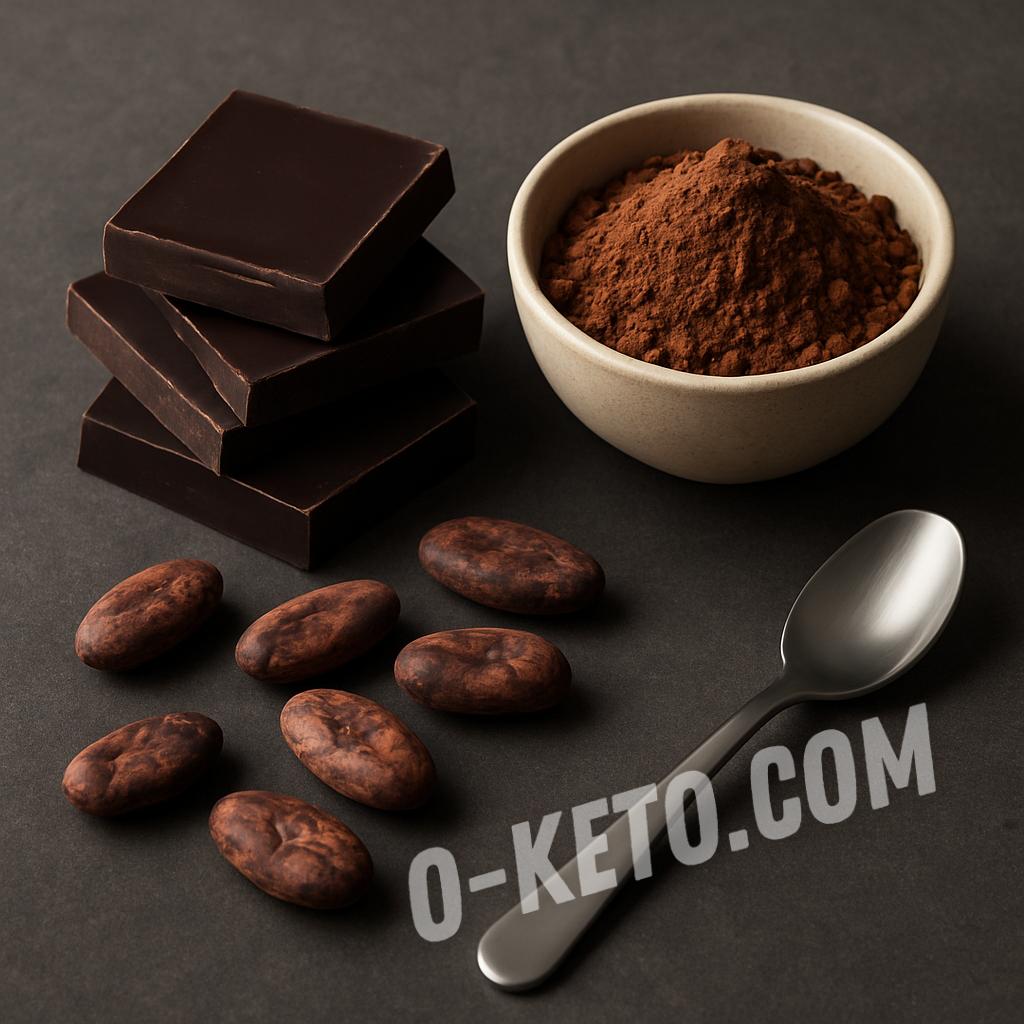
Cocoa powder is made from cocoa mass: some cocoa butter is pressed out of it, and the remaining cake is dried and ground. Therefore, the main parameter of the powder is not only color and aroma but also fat content. It directly affects the texture of the dessert.
| type of cocoa powder | approximate fat content | how it behaves in recipes |
| defatted | less than 10-12% | provides bright color and concentrated flavor but can dry out baked goods |
| medium fat | approximately 12-20% | universal option for baking, creams, and drinks |
| high-fat | more than 20% | provides softness, velvetiness, and a rounder flavor |
For ganaches, truffles, mousses, and moist cakes, a higher fat powder is often more convenient. It helps achieve a soft, enveloping texture.
For sponges, toppings, and recipes where structure is important, a lower fat powder may be suitable, but more liquid may sometimes be needed in the recipe.
Carbohydrates in cocoa: why the number on the packaging is alarming
On the packaging of cocoa powder, you might see 20-30 g of carbohydrates per 100 g of product, which looks alarming for keto. But it is important to separate total carbohydrates from digestible ones. A significant portion of cocoa carbohydrates is dietary fiber, that is, cellulose.
Fiber does not behave like sugar or starch: it does not provide the same glycemic load. Therefore, when choosing cocoa, it is better to look not only at the “carbohydrates” line but also at the “dietary fiber” line if the manufacturer provides it.
| what to look for | how to interpret |
| total carbohydrates | may seem high because they include fiber |
| dietary fiber | the more there is, the lower the share of actually digestible carbohydrates |
| sugars | an important line for keto: there should be little sugar in pure cocoa |
| composition | ideally only cocoa powder, without sugar, maltodextrin, and flavored mixtures |
Defatted cocoa powder often contains more fiber by percentage because it has less fat, and relatively more dry solids. This is good for nutritional value but can change the texture: the dough becomes drier and sometimes requires more liquid or fat.
Natural and alkalized cocoa powder
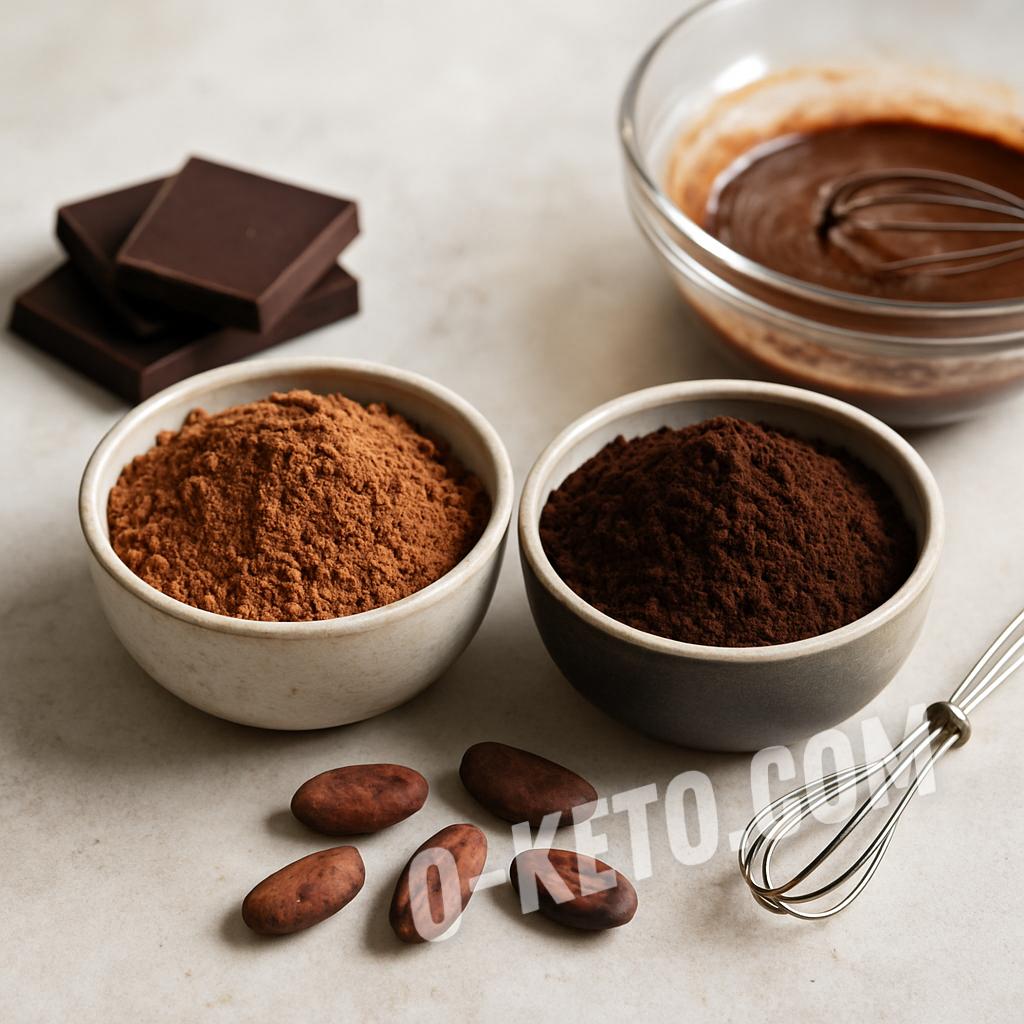
Natural cocoa powder is dried and ground cocoa cake without additional processing. It is usually lighter, with a reddish tint and natural acidity. This acidity is important in baking if the recipe contains baking soda: the acid helps the reaction and can improve leavening.
Alkalized cocoa powder, or Dutch-processed cocoa, is treated with a weak alkaline solution, such as potassium carbonate. This is a standard food technology. It reduces acidity, makes the flavor milder, the color darker, and the aroma rounder.
| type of cocoa | flavor and color | where it is more convenient to use |
| natural | lighter, more acidic, with sharper cocoa notes | baking with soda, recipes where natural acidity is needed |
| alkalized | darker, milder, deeper, more chocolatey in perception | mousses, creams, drinks, sauces, smooth desserts |
Alkalized powder often dissolves better, especially in cold liquids. It clumps less and is easier to turn into a smooth mass. Therefore, for cream, mousse, hot chocolate, or sauce, it is usually more predictable.
How to choose for a specific dessert
The same cocoa powder does not have to be perfect for all tasks. It is better to choose it based on the texture you need to achieve.
| task | what to choose |
| mousse or cream | alkalized cocoa powder of medium or high fat |
| ganache or truffles | high-fat cocoa powder or 95-99% chocolate |
| brownies or moist cake | high cocoa percentage chocolate plus medium fat cocoa |
| sponge | natural cocoa powder if the recipe contains soda, or alkalized if eggs and leavening agents provide the rise |
| topping | defatted or medium-fat powder with a bright aroma |
| drink | alkalized powder because it mixes more easily |
If the recipe has already been developed for a specific type of cocoa, substituting it may change the result. A higher fat powder will make the flavor milder and the texture softer, while a lower fat one may enhance the chocolate flavor but make the product drier.
What to look for on the packaging
For keto desserts, the packaging is more important than a pretty name. It is better to quickly check a few points than to be surprised by the taste, dryness, or excess carbohydrates later:
- in the composition of chocolate, cocoa products should be at the top;
- for low-carb desserts, it is better to choose 95-99% cocoa chocolate or unsweetened chocolate with a clear composition;
- there should be no sugar, maltodextrin, or sweet mixtures in cocoa powder;
- the fat content of the powder should be matched to the texture of the recipe;
- total carbohydrates in cocoa should be read together with dietary fiber;
- natural and alkalized cocoa powder should not be considered completely interchangeable.
Conclusion
Good chocolate for keto desserts starts with cocoa products at the top and minimal sugar. In 95-99% chocolate, the small 1-3% of sugar often works as a flavor balance rather than as full sweetness, especially if the bar is used in small portions in the dessert.
With cocoa powder, three things are important: fat content, fiber amount, and processing method. Fat content affects softness and moisture, fiber explains why total carbohydrates on the label do not always equal sugar load, and the natural or alkalized type determines flavor, color, solubility, and behavior in the recipe.
Sources
- Types of Food Ingredients — U.S. Food and Drug Administration
- Codex Standard for Chocolate and Chocolate Products — Codex Alimentarius Commission
- FoodData Central Foundation Foods Documentation — U.S. Department of Agriculture
- Food Labeling Guide — U.S. Food and Drug Administration


