


Malabsorption
With malabsorption, the body may receive nutrients with food but absorb them incompletely. This is especially important for vitamin B12 deficiency and other nutrient gaps, when the diet itself is not the only issue; the intestine and stomach must also be able to absorb what is eaten.




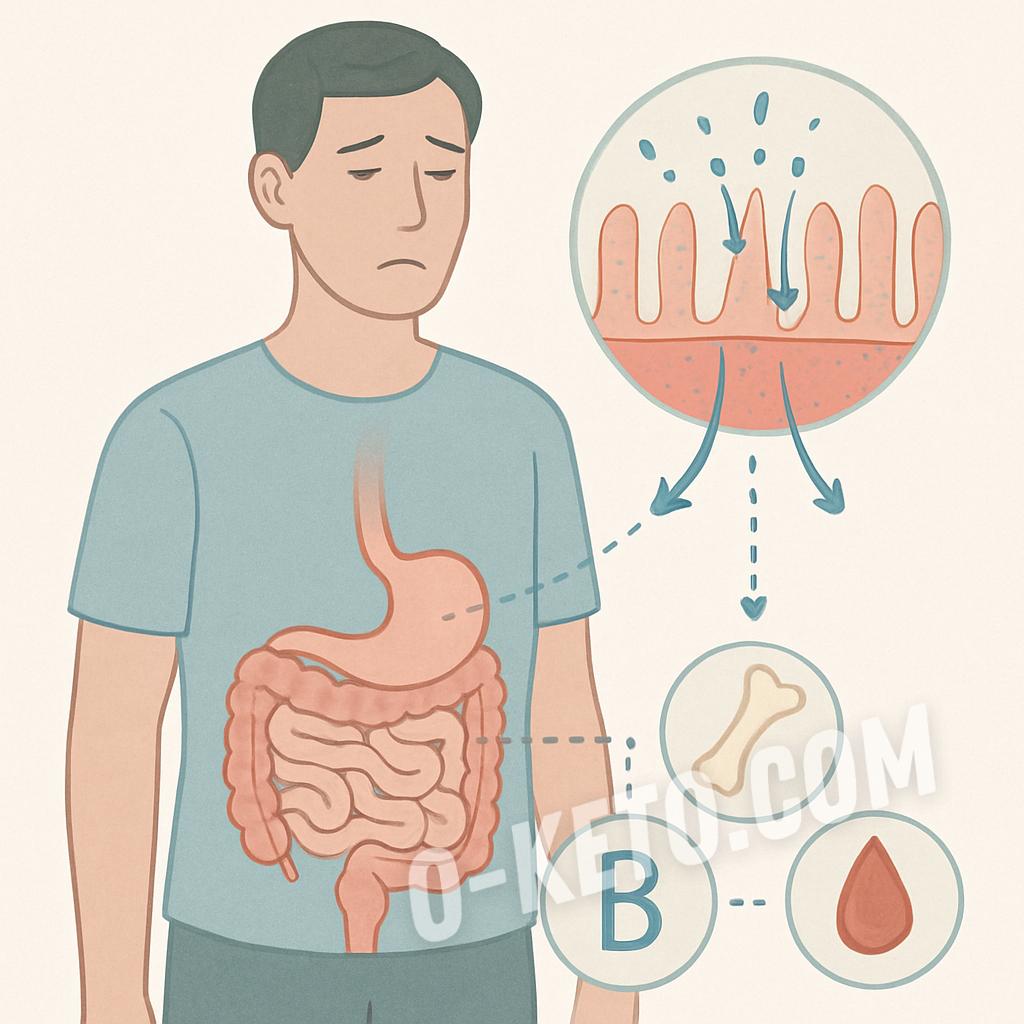
Malabsorption is a condition in which the intestine does not fully absorb nutrients, vitamins, minerals, or other important components of food. In practical terms it is not one single disease, but a syndrome that can develop for different reasons: after stomach or intestinal surgery, with inflammatory bowel disease, celiac disease, impaired digestion, enzyme deficiency, chronic pancreatic disease, or other problems that interfere with normal food assimilation. This matters because even a good diet does not guarantee adequate nutrition if substances are not absorbed properly.
Malabsorption often does not appear as one clear complaint, but as a combination of signs: weight loss, bloating, unstable stool, weakness, anemia, deficiencies of iron, B12, folate, fat-soluble vitamins, and an overall decline in nutritional status. Sometimes deficiency states come to the foreground before intestinal symptoms do. That is why malabsorption syndrome should be considered more broadly than simple discomfort after eating.
Why absorption can be impaired
Normal nutrient absorption depends on several stages: adequate acidity and processing of food in the stomach, enzyme activity, bile flow, the integrity of the small-intestinal lining, and a sufficient functional length of intestine. If even one link is disrupted, some nutrients may be absorbed worse. In real clinical practice this can happen after gastrectomy, intestinal surgery, Crohn’s disease, celiac disease, SIBO, chronic pancreatitis, and other conditions.
For vitamin B12, the stomach, intrinsic factor, and the final sections of the small intestine are especially important. This is why the risk of B12 deficiency becomes noticeably higher after stomach surgery and in some intestinal diseases, even when the diet is good.
How malabsorption may show itself
Some people mainly have intestinal symptoms: bloating, rumbling, unstable stool, fatty stool, pain after meals, or poor tolerance of certain foods. In others, the consequences of deficiencies are more prominent: anemia, hair loss, fatigue, swelling, loss of muscle mass, numbness, cramps, reduced immune resilience, or a general worsening of well-being. Sometimes a person treats individual deficiencies for a long time without realizing that the problem is not the amount of supplements, but absorption itself.
Malabsorption should therefore be suspected especially when several deficiencies occur together and correction through diet and standard supplements works less well than expected. This is already a reason to look not only at what to replace, but also at why replacement is working poorly.
Connection with vitamin B12 deficiency
Vitamin B12 is one of the nutrients that is especially sensitive to absorption problems. If stomach function is impaired, intrinsic factor is reduced, part of the stomach has been removed, or there is disease of the terminal ileum, deficiency may develop quite predictably. This is why medical correction plans for B12 in malabsorption and after gastrectomy often differ from ordinary support in people without absorption problems.
In practical terms, this means that even large vitamin doses do not always have the same effect in different people. Sometimes a longer plan, closer monitoring, or another route of correction is needed. The cause of impaired absorption determines how easily the level can be restored.
When to see a doctor
Medical evaluation is especially important if there is weight loss, chronic loose or fatty stool, anemia, multiple deficiencies, marked weakness, a history of stomach or intestinal surgery, inflammatory bowel disease, suspected celiac disease, or long-lasting digestive complaints. It is also important to be evaluated if deficiencies quickly return after a short-term improvement.
A doctor helps determine at which stage absorption is breaking down, which tests are truly needed, and which nutrients should be monitored especially carefully. This is more useful than endlessly changing supplements without understanding the mechanism of the problem.
How correction is usually approached
The approach depends on the cause of malabsorption. Sometimes the underlying intestinal disease must be treated, sometimes enzyme insufficiency must be corrected, sometimes the plan must take into account the state after surgery, and sometimes deficiencies need long-term monitoring and individual replacement. With vitamin B12, a more intensive or longer correction plan is often discussed than in people with ordinary dietary deficiency.
The main practical idea is that in malabsorption, the effectiveness of support cannot be judged only by the fact that a vitamin is being taken. It is important to look at laboratory results, symptoms, and the cause of the syndrome. Then it becomes clearer whether the plan is working and whether it adequately reflects the needs of the individual person.
Practical takeaway
Malabsorption is a condition in which deficiencies are often the result of a deeper problem with assimilation. Therefore, when absorption is poor and after gastrectomy, it is especially important not simply to add nutrients, but to monitor the result and understand the mechanism of the disorder. This approach helps correct vitamin B12 deficiency and other deficits more safely when they would otherwise keep returning.
For the patient, this means a simple thing: if the body absorbs poorly, taking vitamins may not be enough by itself. A more precise strategy is needed, built around the cause of the syndrome, follow-up testing, and thoughtful replacement of the substances that are affected most.
Modern assessment of malabsorption
Current assessment starts by looking for the cause rather than trying to measure a single “percentage of absorption” for the whole diet. A clinician combines medical and medication history with blood tests, nutritional assessment, stool studies, breath tests, endoscopy, or imaging when indicated. The choice depends on whether fat, protein, or carbohydrate digestion is suspected and whether inflammation, surgery, or pancreatic disease is present.
Nutrient results also need context. Inflammation can change blood concentrations of vitamins and minerals, so one value may not reflect tissue stores. When malabsorption is confirmed, nutritional status and deficiencies are assessed alongside treatment of the cause instead of removing foods without a diagnostic reason.
Sources
- European Consensus on Malabsorption — Part 1: Definitions, Clinical Phenotypes, and Diagnostic Testing; A look inside the gut as a clue to nutritional status; Pitfalls in the interpretation of blood tests used to assess and monitor micronutrient nutrition status
- European Consensus on Malabsorption — Part 1: Definitions, Clinical Phenotypes, and Diagnostic Testing; A look inside the gut as a clue to nutritional status; Pitfalls in the interpretation of blood tests used to assess and monitor micronutrient nutrition status
If you have any questions about the term "Malabsorption", you can ask them to AI. Please note, a low-cost OpenAI model is used. It may answer questions about disease treatment with errors!


 1 / 4
1 / 4 1 / 4
1 / 4


 1 / 4
1 / 4
 1 / 4
1 / 4