


Androgenetic alopecia
Androgenetic alopecia is not simply general hair shedding but a gradual miniaturization of follicles driven by androgen sensitivity and genetics; early recognition, correction of compounding deficiencies, and realistic long-term strategy matter more than random cosmetic measures.




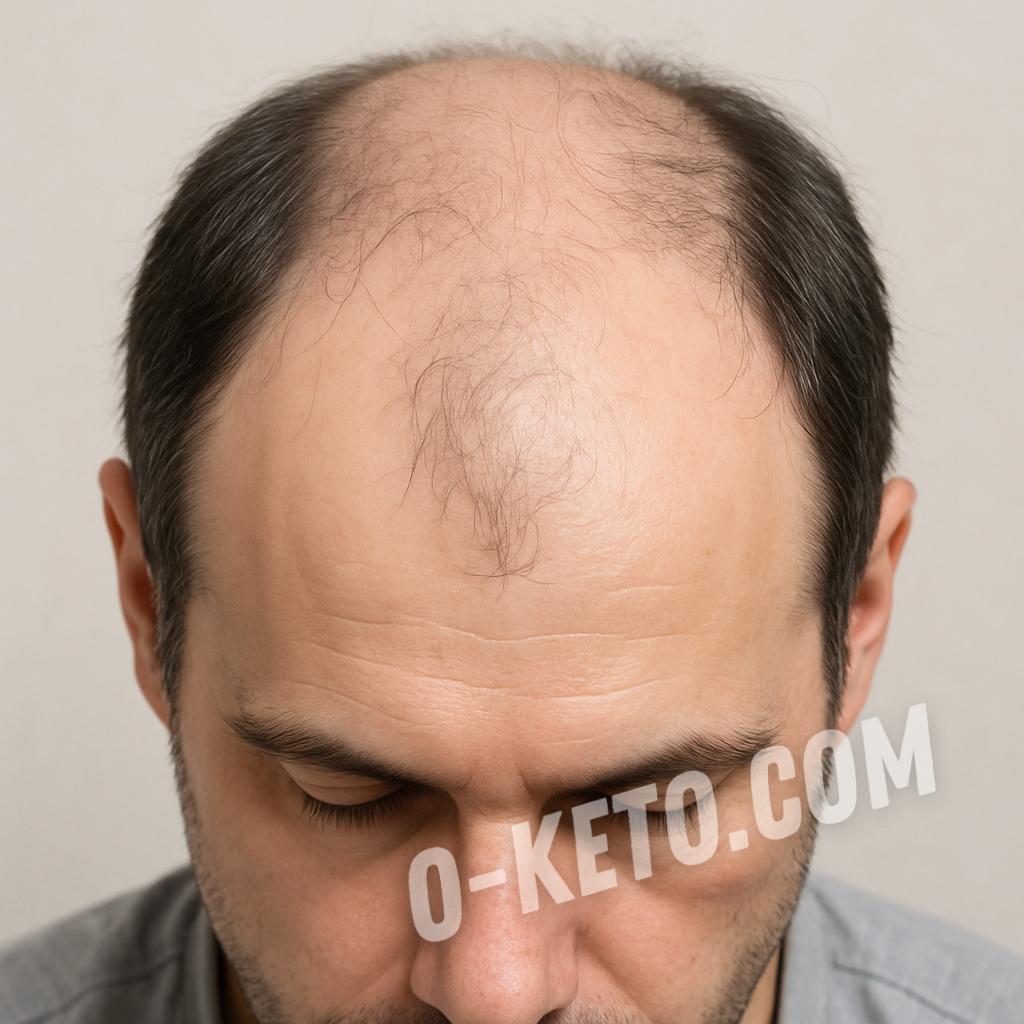
Androgenetic alopecia, often shortened to AGA, is the most common form of progressive hair thinning in both men and women. The core issue is not an acute inflammatory event and not just a temporary vitamin shortage. It is a long-term sensitivity of hair follicles to androgens, especially dihydrotestosterone, together with a genetic tendency that makes some follicles progressively weaker over time. Because of this, the growth phase of the hair cycle becomes shorter, the shaft becomes thinner and less durable, and the follicle gradually miniaturizes. In practical terms, the person often notices reduced density, widening of the central part, thinning of the crown, recession of the frontal-temporal area, or the feeling that hair volume never truly comes back after shedding episodes. This is why AGA should be separated from temporary telogen shedding after stress, illness, childbirth, weight loss, or obvious nutrient depletion.
What happens to the follicles
The defining feature of androgenetic alopecia is gradual change rather than sudden disappearance of hair. With each cycle, the follicle may produce a shorter, finer, weaker hair. Healthy terminal hairs normally stay in an active growth phase for a relatively long time and maintain a meaningful shaft diameter. In AGA, the growth phase becomes shorter, miniaturized hairs increase, and the scalp starts to show through more clearly. In men this often appears as frontal recession and thinning on the vertex. In women it more often shows up as diffuse thinning across the top of the scalp and widening of the part line, usually without the classic male recession pattern. This visual pattern matters because it helps distinguish AGA from other causes of shedding where the problem may be iron deficiency, hypothyroidism, severe stress, post-infectious telogen effluvium, or inflammatory scalp disease.
How the hair growth cycle works
To understand gradual thinning, it helps to look at the hair cycle. A follicle does not produce the same hair continuously: it passes through an active growth phase, a short transition phase, a resting period, and shedding of the old shaft. A new cycle then begins. The follicles on the scalp are not synchronized, which is why all hairs do not normally shed at the same time.
Anagen is the long phase in which a new shaft is formed and grows. Catagen lasts only a few weeks and involves structural remodeling and reduced follicle activity. During telogen, the follicle rests, while exogen refers to the release and shedding of the club hair. A follicle may remain empty for a period between shedding and the appearance of a new hair; this interval is called kenogen. Its duration varies, and a longer interval in patterned hair loss may add to the visible reduction in density.
In AGA, the issue is not only that hairs are shed but that the proportions of the cycle change: anagen becomes shorter in susceptible follicles, and each new shaft may be thinner. This is why support or treatment cannot be judged after a few days or weeks. Consistent photographs and observation over several months are more useful for separating normal cycle fluctuations from a persistent change in density.
| Phase | What happens | Why it matters in AGA |
| Anagen | Active growth and shaft production | A shorter phase gives the hair less time to grow and maintain its diameter. |
| Catagen | Transitional remodeling of the follicle | The follicle reduces activity and prepares for the resting period. |
| Telogen and exogen | Rest, release, and shedding of the club hair | Shedding alone does not identify the cause; the overall pattern and distribution across phases matter. |
| Kenogen | An interval during which the follicle remains empty | A longer interval can make thinning more visible, especially when miniaturization is also present. |
Why androgens matter, but not in a simplistic way
AGA is often reduced to the idea that “testosterone causes hair loss,” but the real picture is more nuanced. The problem is not always a dramatically elevated androgen level in blood tests. A major role is played by local sensitivity of hair follicles and the activity of 5-alpha-reductase, the enzyme that converts testosterone into dihydrotestosterone. One person may have laboratory values in the normal range and still show clear AGA, while another with similar numbers may lose hair much more slowly. In women, the picture is often influenced further by polycystic ovary syndrome, insulin resistance, chronic stress, low protein intake, vitamin D deficiency, and iron depletion. These factors do not necessarily create AGA from nothing, but they can make the pattern more obvious and accelerate visible thinning.
How to distinguish AGA from other types of hair loss
For practical decision-making, it is important not to confuse androgenetic alopecia with telogen effluvium. After a viral infection, surgery, childbirth, severe stress, or abrupt caloric restriction, hair can shed diffusely and dramatically. That does not automatically mean AGA. In telogen effluvium, the complaint is often the sudden volume of shedding itself, while in AGA the bigger clue is progressive thinning and loss of density in a characteristic distribution. Another common mistake is to blame everything on nutrient deficiencies without examining the pattern of hair loss. Iron deficiency, low zinc, low selenium, poor protein intake, low B12, folate problems, and hypothyroidism can all worsen hair quality and increase shedding, but if the scalp pattern clearly points toward crown thinning or a widening part, correction of deficiencies alone may not fully stop the androgen-related process. Mixed cases also exist, and they are common enough to matter in real life.
How the severity of patterned hair loss is described
After examining the scalp, a clinician may describe not only the distribution of thinning but also its severity. Visual scales help compare the hair pattern over time, discuss treatment response, and identify which areas have changed. A scale is not a diagnosis: it records the visible degree of thinning at a particular moment but does not identify the cause by itself.
In men, the Hamilton–Norwood scale is commonly used, with seven main stages. It describes progression from minimal changes in the hairline to more pronounced recession and vertex thinning. In women, the pattern is often described with the Ludwig scale, which has three degrees of diffuse thinning across the top of the scalp, or with the five-grade Sinclair scale, which is useful for assessing a widening part and reduced density. Modified versions are used in some clinics, so the same stage number does not always represent exactly the same appearance.
The practical value of a scale is that it establishes a baseline instead of relying only on memory or a subjective impression. If shedding starts quickly, becomes diffuse, or is accompanied by itching, pain, scaling, or inflammation, a scale is not enough: the scalp needs examination, trichoscopy, and assessment of possible additional causes.
| Scale | What it is used for | What to keep in mind |
| Hamilton–Norwood | Typical patterned hair loss in men | Usually uses stages I–VII; the frontal-temporal hairline and vertex are compared, but versions can vary. |
| Ludwig | Diffuse thinning in women | Uses grades I–III; it describes hair density, not the specific cause of shedding. |
| Sinclair | Central part width and density in women | Usually uses grades 1–5; the result depends on examination technique and comparison conditions. |
What evaluation usually helps
When AGA is suspected, useful evaluation goes beyond simply counting shed hairs. Dermatoscopic examination may show miniaturization, variation in shaft diameter, and the typical pattern of affected follicles. On the laboratory side, ferritin, complete blood count, vitamin B12, folate, vitamin D, thyroid markers, and in some cases zinc, copper, glucose, and insulin can all be relevant. In women, androgen profile, prolactin, and signs of polycystic ovary syndrome may also matter depending on the history. The reason this broader workup is useful is that even when AGA is the main diagnosis, severity and progression are often amplified by systemic issues such as metabolic stress, poor sleep, insulin resistance, nutrient depletion, or endocrine instability.
What is usually discussed in treatment and support
Management depends on sex, age, severity, the speed of progression, and the presence of other causes of shedding. In ordinary practice, topical and systemic options may be considered to slow follicle miniaturization and support the growth phase. Nutritional and supplement-oriented support usually focuses on protein status and deficiency correction only when real deficits are present, rather than throwing a random mix of products at the problem. Ingredients that interact with the androgen pathway, such as saw palmetto, are also discussed in some protocols, but they should not be treated as instant cosmetic fixes or as guaranteed replacements for evidence-based medical treatment in more advanced cases. Another important practical point is timing: hair cycles are slow, so meaningful assessment usually takes months rather than a few weeks.
Support regimens for AGA
Once the diagnosis has been confirmed, a structured support plan begins by identifying factors that may intensify follicle miniaturization and by checking for signs of deficiency. In a naturopathic approach, zinc correction is treated as the foundation, while plant extracts and topical products are used as additional directions. This order keeps deficiency correction, influence on the androgen pathway, and cosmetic care from being mixed into one undefined procedure.
Zinc and vitamin A
Organic zinc forms are used in the nutritional regimen, including citrate, glycinate, chelate, or another form that clearly states the amount of elemental zinc. A commonly used target is 30–50 mg of elemental zinc per day; the daily amount can be divided into two doses when needed. Zinc is taken with a substantial meal because taking it on an empty stomach more often causes nausea and is less well tolerated.
Vitamin A is used in the same regimen at 25,000 IU per day. This is not an ordinary food portion, so the form, duration, and monitoring are selected individually; pregnancy, liver disease, and other products containing retinol require particular attention. Zinc and vitamin A do not replace evaluation when hair loss is severe or rapidly progressive.
Standardized Serenoa repens extract
To address the androgen pathway, the approach considers a standardized Serenoa repens, or saw palmetto, extract rather than simple fruit powder. A working reference is 320 mg of extract per day, standardized to approximately 85–95% fatty acids, for at least six months. An active phase with two or three daily doses is also described, but that schedule applies specifically to a standardized product and cannot automatically be transferred to every saw palmetto supplement.
If the label states only 45% fatty acids, the extract cannot be compared one-to-one with an 85–95% product because the amount of active constituents is lower at the same mass. The relevant figure is therefore the actual standardization percentage, not merely the large milligram number on the front of the package. The first assessment is made after three to six months, using photographs and hair density recorded under the same conditions.
Curcumin, piperine, and a topical serum
Curcumin at 1,000–3,000 mg per day is considered as an additional direction, sometimes together with piperine to alter absorption. This is an adjunct rather than a replacement for evaluating the causes of hair loss; people taking medication should check possible interactions in advance.
For topical care, one oil serum combines 2 ml of jojoba oil, the contents of one softgel containing a standardized black-pepper extract with 5 mg of extract and 4.75 mg of piperine, and one or two drops of rosemary, clary sage, frankincense, or bay essential oil. The mixture is applied to the scalp in the evening, with about three months used as the minimum assessment period. Test the mixture on a small area first and do not apply it to irritated or damaged skin.
Monitoring and additional procedures
Progress is followed through standardized photographs, examination, and, when useful for monitoring, repeat dihydrotestosterone testing. A single DHT value does not establish the diagnosis, so repeating it earlier than three months usually adds little practical information. If the expected trend is absent after three to six months, review adherence, sleep, nutrition, accompanying deficiencies, and the diagnosis rather than simply increasing doses indefinitely.
Some naturopathic protocols also consider organic silicon administered once a week; the course is individualized, with four to ten procedures often used as a practical reference. Warm baths with ordinary rock salt for about 30 minutes are also used. These procedures should not replace diagnostic work-up or primary treatment, and injectable methods belong only in a medical setting after contraindications have been assessed.
The overall logic is sequential: first clarify the type of alopecia and possible deficiencies, then choose one understandable basic protocol and assess it over months. The more accurately the starting density, pattern of thinning, and composition of each supplement are recorded, the easier it is to understand what changed and which part of the plan needs review.
What makes the outlook worse
The worst pattern is often delay. People may spend a long time on shampoos, scalp massage, or random vitamins without ever clarifying whether the loss pattern is truly androgenetic. Repeated crash diets, chronic sleep loss, low protein intake, iron deficiency, uncontrolled insulin resistance, and persistent stress can all worsen the course. Once miniaturization is advanced, restoring previous density becomes much harder than slowing early decline. For that reason, AGA is best understood not as a trivial cosmetic annoyance but as a long-term biological process that benefits from early recognition, pattern-based diagnosis, and a patient, structured approach instead of a search for one miracle jar.
Sources
- Zinc — Health Professional Fact Sheet — National Institutes of Health, Office of Dietary Supplements;
- Vitamin A and Carotenoids — Health Professional Fact Sheet — National Institutes of Health, Office of Dietary Supplements;
- A randomized controlled trial comparing the efficacy of topical rosemary oil and minoxidil 2% for the treatment of androgenetic alopecia;
- The effectiveness of saw palmetto in men with androgenetic alopecia: a systematic review.
If you have any questions about the term "Androgenetic alopecia", you can ask them to AI. Please note, a low-cost OpenAI model is used. It may answer questions about disease treatment with errors!


 1 / 4
1 / 4 1 / 4
1 / 4


 1 / 4
1 / 4 1 / 4
1 / 4 1 / 4
1 / 4